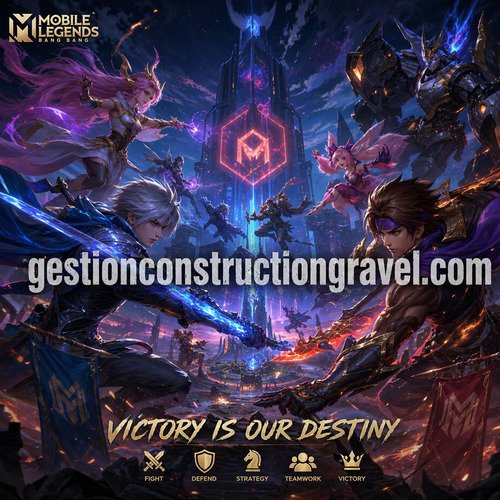
gestionconstructiongravel.com – Mobile Legends is often interpreted as a fast-paced MOBA focused on mechanics, reflexes, and individual outplays. While those elements exist, they only represent the surface layer of a much deeper system. At its core, the game is a structured environment of decision pressure, where heroes function as tools for controlling space, time, and information.
Every hero in Mobile Legends has a strategic identity that extends beyond combat. They are not simply damage dealers or frontline units, but instruments used to manipulate enemy movement and restrict decision-making. The real game is about forcing the enemy into uncomfortable situations until their options become predictable and punishable.
When this system is understood, gameplay becomes less reactive and more engineered. Each rotation, each wave, and each fight becomes part of a controlled process rather than spontaneous chaos.
Hero Roles as the Structural Foundation of Competitive Game Control
Tank heroes such as Atlas, Tigreal, Khufra, Minotaur, and Akai form the structural backbone of coordinated team play. Their purpose is not damage output but control over space, vision, and initiation timing.
A tank influences the map even without fighting. When absent from vision, enemy teams slow down, hesitate, and avoid risky rotations. When visible, they force defensive positioning and restrict movement options. This creates constant pressure that shapes macro decisions across the entire map.
In teamfights, tanks determine the exact moment combat begins. A successful initiation can instantly collapse enemy formation and create a winning state. However, tank execution is highly timing-sensitive—early engagement wastes synergy, while late engagement allows enemies to reset and disengage.
Tanks also function as vision anchors. They enter fog first, check bushes, and absorb initial burst damage to reveal enemy positioning. Without this function, teams lose information control and become vulnerable to hidden rotations and ambush setups.
Fighters as Sustained Pressure Engines and Midgame Structural Anchors
Fighter heroes like Yu Zhong, Arlott, Terizla, Thamuz, and Lapu-Lapu operate as hybrid units designed for continuous pressure and sustained influence.
Unlike burst-oriented roles, fighters generate value through repetition—constant lane pressure, repeated skirmishes, and extended fights that force enemy responses over time.
Most fighters begin in the EXP lane, where early wave control and trading gradually evolve into midgame dominance. Their influence increases as objectives become more contested and rotations become more frequent.
What makes fighters strategically valuable is their flexibility. They can initiate fights, hold side lanes, rotate into objectives, or function as secondary frontline depending on team needs.
However, their effectiveness depends on discipline. Overextension leads to punishment, while passive play reduces pressure and allows opponents to control tempo.
Assassins as Precision Disruption Systems and High-Value Execution Units
Assassin heroes such as Ling, Hayabusa, Lancelot, Gusion, and Nolan are designed to eliminate priority targets and destabilize enemy structure at critical timing windows.
Their gameplay is built around opportunity rather than constant presence. They wait for enemy cooldowns, mispositioning, or isolation before striking with high burst damage.
Assassins require advanced map awareness and predictive movement reading. They operate by tracking rotations and identifying moments where the enemy formation is weakest.
Their role is extremely high risk and high reward. A successful execution can immediately shift match momentum, while failure results in loss of tempo and map control.
Because of this, assassins are less about aggression and more about precision exploitation of mistakes.
Game Phases and Hero Influence Across Strategic Progression
Early game is focused on establishing lane stability, resource efficiency, and controlled scaling. Some heroes dominate early fights, while others prioritize long-term development.
Early advantages are created through wave control, jungle efficiency, and positional discipline. These small advantages accumulate into long-term map control.
Even without kills, early pressure restricts enemy rotations and delays item progression, shaping midgame conditions.
Mid Game as the Phase of Rotation Pressure and Objective Structuring
Mid game is where Mobile Legends becomes highly dynamic. Teams begin grouping, rotating, and contesting objectives such as Turtle, turrets, and jungle control.
Heroes with strong midgame presence—especially fighters, roamers, and utility mages—become central to tempo control.
Map control becomes the dominant objective. Teams that rotate efficiently, control vision, and occupy key areas determine where fights occur before they start.
This phase is highly punishing, where small mistakes quickly snowball into loss of objectives and map dominance.
Late Game as the Phase of Execution Precision and Win Condition Resolution
Late game is defined by full item builds and maximum hero scaling. Marksmen and scaling mages become primary win conditions capable of ending fights instantly.
Positioning becomes the most critical factor. One misstep can result in immediate elimination due to high burst damage.
Teamfights become slow and deliberate. Instead of forcing engagements, teams wait for optimal conditions such as cooldown advantages or enemy mispositioning.
Protecting core damage dealers becomes the highest priority, with tanks and supports ensuring survival and sustained output.
Cooldown Tracking and Temporal Advantage Creation
High-level gameplay depends heavily on tracking enemy ability cooldowns. Knowing when key skills are unavailable creates safe windows for engagement.
Teams that understand cooldown cycles gain control over fight timing and can consistently force favorable scenarios.
Spatial Awareness and Positional Optimization
Positioning is not only survival—it is control over influence zones. Every hero has an optimal area where it contributes maximum value.
Frontliners control entry space and vision, damage dealers maintain safe output zones, and assassins control flanking pressure. Misalignment between roles often leads to instant collapse.
Decision Efficiency and Strategic Risk Management
Every action in Mobile Legends carries opportunity cost. Farming, rotating, fighting, and defending all require evaluation of impact versus risk.
Strong players prioritize high-impact decisions over frequent low-value actions, focusing on efficiency rather than activity volume.
Conclusion Mobile Legends Heroes and the Strategic Logic of Control, Adaptation, and Competitive Gameflow Engineering
Mobile Legends heroes form a deeply interconnected strategic system where drafting, macro control, and execution all determine match outcomes.
Tanks control space and initiation, fighters maintain sustained pressure, assassins execute key targets, marksmen scale into late-game win conditions, mages control zones, and supports stabilize team structure.
True mastery is not defined by mechanics alone, but by understanding timing, positioning, and decision pressure across the entire map. When these systems align, heroes become tools of structured control rather than simple combat units.
Ultimately, victory belongs to the player who understands how to engineer the flow of the game—forcing opponents into limited and predictable choices until defeat becomes unavoidable.
