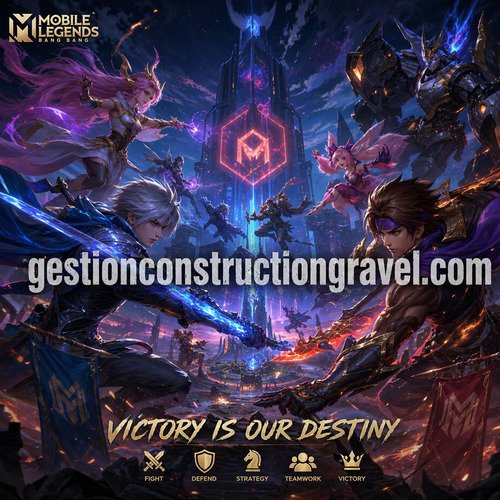
gestionconstructiongravel.com – In the competitive landscape of Mobile Legends: Bang Bang, hero mastery evolves far beyond learning skills, combos, or lane matchups. At an advanced level, heroes become extensions of strategic thinking—tools used to manipulate tempo, control space, and shape how opponents make decisions under pressure.
What truly defines high-level performance is not only execution, but the ability to interpret the game as a living system. Every rotation, every wave, and every cooldown contributes to a larger structure that determines whether a team controls the match or reacts to it. This article explores deeper layers of mastery: combat rhythm, macro intelligence, and structured winning patterns that consistently lead to victory.
Combat Rhythm and Hero Interaction Flow
Every fight in Mobile Legends has an internal rhythm. It is not random chaos—it is a structured sequence of engage, response, cooldown usage, and repositioning. Understanding this rhythm is what separates reactive players from controlled decision-makers.
Team fights do not begin with full damage output; they begin with engage cycles. Tanks or initiators set the tempo by forcing positioning errors, followed by layered damage from mages and assassins. If this sequence is broken, fights become fragmented and ineffective.
Ability synchronization is critical. When skills are used without coordination, damage becomes wasted or misaligned. However, when abilities are layered correctly—crowd control first, burst second, sustain damage last—the result is often instant fight control.
At higher levels, teams track not just enemy positioning but also cooldown cycles. Knowing when enemy ultimates are unavailable creates structured windows for aggression, allowing clean and efficient engagements.
Spacing Control and Damage Avoidance Mechanics
Spacing is one of the most important defensive skills in the game. It determines whether a hero survives long enough to contribute meaningfully in fights. Proper spacing is not static positioning—it is constant micro-adjustment based on enemy threat zones.
Marksmen and mages rely heavily on spacing to remain effective. Staying too close exposes them to assassins, while staying too far reduces damage output. The ideal position is constantly shifting depending on vision, cooldowns, and frontline movement.
Spacing also plays a psychological role. A well-spaced player forces enemies to hesitate, unsure whether engaging will result in failure or punishment. This hesitation slows down enemy execution and creates openings for counterplay.
Fight Tempo and Momentum Control
Fight tempo refers to how fast or slow a battle unfolds. Some compositions thrive in fast burst fights, while others excel in prolonged engagements. Controlling tempo means forcing fights into conditions that favor your team.
Fast tempo favors assassins and burst mages, where quick eliminations decide outcomes. Slow tempo benefits tanks and sustained damage dealers who gain value over time. Recognizing which tempo suits your composition is essential for consistent success.
Momentum shifts occur when one team loses control of tempo. Once momentum is lost, even mechanically superior teams struggle to recover unless they reset properly and avoid forced engagements.
Macro Intelligence and Map-Level Decision Making
Macro intelligence is the ability to read the entire map as a system rather than focusing on isolated lanes. In high-level play, macro decisions often determine outcomes more than individual mechanics.
Rotation is not just movement—it is synchronization between lanes, jungle, and objectives. Effective rotation requires understanding when multiple lanes can be pressured simultaneously.
When one lane pushes forward, it creates forced responses from the enemy team. This opens opportunities in other areas of the map. High-level teams use this concept to stretch enemy resources until cracks appear.
Synchronization ensures that rotations are not random. Every movement has purpose: either creating pressure, securing vision, or preparing for objectives.
Objective Windows and Strategic Timing Control
Objectives like Turtle and Lord are not just targets—they are timing windows. These windows are created by prior map control, wave positioning, and jungle pressure.
A team that arrives early to objective areas with wave advantage holds a significant strategic edge. They force enemies to respond under disadvantageous conditions, often leading to forced fights or objective loss.
Understanding timing also includes knowing when not to contest. Sometimes giving an objective is more optimal than forcing a losing fight, especially when scaling or defensive conditions are favorable.
Map Pressure Layers and Multi-Lane Strategy
Map pressure is built in layers. One lane alone does not create pressure—it is the combination of multiple lanes pushing simultaneously that creates structural tension.
When two or more lanes are pushed, enemies must divide attention. This reduces their ability to group for fights or contest objectives effectively. This concept is often called pressure layering.
Heroes with strong wave clear or mobility play a crucial role in maintaining these layers, ensuring that pressure is continuous and not easily reset by opponents.
Winning consistently requires more than reactive play. It requires structured patterns that guide decision-making from early game to late game.
Early Game Structure and Controlled Aggression
Early game is about establishing structure, not chaos. Controlled aggression means engaging only when conditions are favorable—wave priority, jungle position, or level advantage.
Random fights often lead to unstable outcomes. Structured aggression ensures that every fight has a purpose, whether it is gaining vision, securing buffs, or controlling lanes.
Teams that maintain early structure avoid unnecessary risks and create a stable foundation for mid-game transitions.
Mid Game Conversion Systems and Advantage Expansion
Mid game is where advantages must be converted. A lead that is not converted into objectives, towers, or map control is effectively wasted.
Conversion systems include rotating after kills, invading jungle immediately, or pushing lanes before resetting. These systems ensure that every advantage produces long-term impact.
Without conversion discipline, teams often stagnate, allowing opponents to recover and regain control.
Late Game Closure Logic and Risk Minimization
Late game requires extreme discipline. One mistake can decide the entire match, making risk management the highest priority.
Closure logic focuses on identifying safe conditions for ending the game. This includes enemy death timers, wave positioning, and vision control around the base.
Instead of forcing unpredictable fights, high-level teams wait for guaranteed advantages before committing to final pushes.
Conclusion Elite Hero Mastery in Mobile Legends: Macro Intelligence, Combat Rhythm, and Winning Structures
Mastery in Mobile Legends: Bang Bang is ultimately defined by the ability to connect micro mechanics, macro intelligence, and structured decision-making into a unified system. Combat is not random—it follows rhythm. Map control is not optional—it is foundational. And winning is not accidental—it is the result of consistent execution of structured patterns.
Players who rise beyond average understanding begin to see the game differently. Heroes are no longer isolated characters, but components of a larger strategic machine. Every rotation, every spacing decision, and every objective call becomes part of a controlled system designed to generate advantage over time.
When this level of understanding is achieved, gameplay transforms from reactive fighting into intentional dominance—where every action is part of a larger, deliberate path toward victory.
