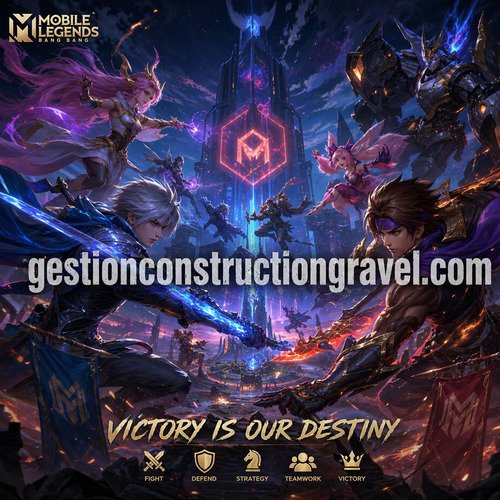
gestionconstructiongravel.com – Mobile Legends: Bang Bang, when examined at its highest level of play, is not simply a competitive MOBA but a structured system of continuous decision loops, adaptive pressure cycles, and controlled battlefield intelligence. Every hero functions as a node in a larger network of influence where timing, information flow, and spatial control determine the outcome of the match long before the final push occurs.
In this framework, winning is not about individual brilliance or isolated mechanical outplays. It is about understanding how systems interact, how pressure accumulates, and how small decisions compound into irreversible strategic advantages.
Systemic Gameplay Intelligence and Multi-Layer Decision Architecture
High-level Mobile Legends is governed by layered intelligence systems where every decision exists inside multiple contextual layers. Players who understand this architecture can consistently predict outcomes and control match flow with precision.
The reactive layer is the most immediate form of intelligence in gameplay. It governs split-second responses such as dodging abilities, engaging fights, and escaping lethal situations. While it appears instinctive, at high levels it is actually based on pattern recognition and predictive modeling.
Instead of reacting purely to visual cues, elite players anticipate actions based on enemy positioning, cooldown cycles, and behavioral tendencies. This allows them to respond before danger fully manifests.
Reactive intelligence is also responsible for micro-adjustments in fights, such as repositioning during skill animations or canceling actions to avoid counter-engagements.
Predictive Tactical Layer and Short-Horizon Planning Systems
The tactical layer extends decision-making into the near future, typically 10 to 40 seconds ahead. This includes predicting rotations, setting up objectives, and controlling wave states.
Players operating at this level constantly evaluate map conditions such as missing enemies, jungle timers, and lane pressure states. These inputs form predictive models that guide movement decisions.
For example, if a wave is pushing and enemies are missing from vision, a skilled player can predict a collapse attempt and adjust positioning before it happens. This predictive capability transforms gameplay from reactive survival into proactive control.
Strategic Intelligence Layer and Win Condition Optimization
The strategic layer governs long-term planning and win condition execution. It ensures that all tactical decisions contribute to a unified goal such as early snowball, mid-game control, or late-game scaling dominance.
At this level, players stop thinking in isolated events and instead evaluate systemic efficiency. Every rotation, fight, or objective must contribute to advancing the win condition or denying enemy progress.
Strategic intelligence is what allows teams to recover from setbacks, stabilize losing positions, or accelerate winning states without losing structure.
Adaptive Pressure Loops and Dynamic Map Control Systems
Pressure in Mobile Legends is not static—it evolves through continuous loops of action and reaction. Understanding these loops allows players to manipulate enemy behavior without constant fighting.
Pressure generation begins with lane control. By pushing waves or freezing them strategically, players create forced responses from opponents.
This response cycle creates openings elsewhere on the map. When an enemy is forced to clear a lane, they cannot simultaneously contest jungle areas or objectives.
Over time, repeated pressure cycles amplify lane influence into full-map control, gradually restricting enemy mobility and decision space.
Adaptive Response Loops and Enemy Behavioral Conditioning
Every action in Mobile Legends triggers a response from the enemy team. Over time, these responses become predictable patterns that can be exploited.
Adaptive players learn to condition enemy behavior. For example, repeated rotations to a lane may force enemies to over-defend, opening other areas of the map for exploitation.
This creates a feedback loop where enemy reactions become liabilities. The more they respond, the more predictable they become.
Rotational Pressure Cascades and Multi-Zone Domination
Rotational pressure cascades occur when pressure in one lane forces responses that open multiple other zones simultaneously.
For example, pushing side lanes while threatening mid forces enemies into split decision-making. This leads to delayed reactions and weakened map coverage.
When cascades are executed properly, they create uncontested objectives and safe map expansion without direct confrontation.
As matches progress into late stages, systems begin to either stabilize or collapse. Understanding collapse mechanics is essential for recognizing when a game is won or still contestable.
Structural Decay and Progressive Map Contraction
Structural decay refers to the gradual loss of map control through turret destruction, jungle loss, and vision denial. As structures fall, the available safe space for the losing team shrinks.
This leads to map contraction, where teams are forced closer to their base and lose access to resources. Contraction significantly reduces strategic options and increases the likelihood of forced engagements.
Over time, structural decay becomes irreversible unless the winning team makes major strategic errors.
Collapse Acceleration Triggers and Critical Failure Points
Collapse does not happen evenly—it accelerates when key triggers are activated. These triggers include losing major objectives, failing to defend waves, or losing coordinated team fights.
Each trigger compounds existing disadvantages, accelerating the breakdown of map control and decision freedom.
At high levels, recognizing collapse acceleration is more important than individual mechanics because it determines whether a team should attempt risky comebacks or stabilize defensively.
System Finalization and Controlled Endgame Resolution
System finalization is the final stage where the winning team removes all remaining recovery options. This includes controlling all lanes, securing vision dominance, and locking objectives.
Controlled resolution ensures that the game ends without risk of reversal. Instead of rushing, teams methodically eliminate defensive structures and deny enemy access to the map.
The final push is not an action—it is the result of complete systemic control.
Conclusion Mobile Legends Hero Mastery Framework: Systemic Gameplay Intelligence, Adaptive Pressure Loops, and Strategic Domination Theory
Mobile Legends, at its most advanced level, is a system of interconnected intelligence layers, adaptive pressure loops, and structured collapse mechanics. Heroes serve as functional components within this system, but victory is determined by how effectively these components are coordinated across time and space.
Reactive, tactical, and strategic intelligence layers work together to shape decision-making. Pressure loops control enemy behavior and map access. Collapse mechanics define how advantages become irreversible.
True mastery is achieved when players understand that the game is not about isolated fights or mechanical execution alone, but about controlling entire systems until victory becomes the only possible outcome.
