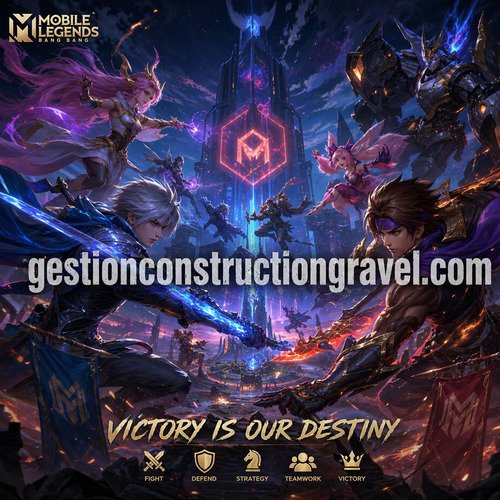
gestionconstructiongravel.com – In today’s gaming landscape, mobile devices are no longer seen only as tools for communication or entertainment in short bursts. They have become platforms for highly competitive games, and among them, Mobile Legends: Bang Bang has established itself as one of the most recognized titles in the world. The game attracts players from all age groups, from casual users looking for quick matches to highly competitive individuals who spend hours refining their skills and climbing ranked ladders.
At first, Mobile Legends seems simple. Two teams enter an arena, choose their heroes, and fight to destroy the opposing base. The controls are accessible, the interface is easy to understand, and matches are designed to fit into a relatively short period. However, the apparent simplicity fades quickly. After a few games, players begin to realize that success depends on much more than attacking enemies. Positioning, timing, resource management, and cooperation all play essential roles.
This is what gives the game its lasting appeal. It can be enjoyed casually, but it also offers a deep competitive experience for those willing to understand its systems. Each match is a unique scenario where players must make decisions under pressure, adapt to unexpected events, and cooperate with teammates to achieve victory.
Understanding the Core Mechanics of Mobile Legends
The standard battlefield in Mobile Legends is divided into three main lanes and one jungle area. Each team starts on opposite sides of the map, and the ultimate goal is to destroy the enemy crystal located at the center of their base. To reach that objective, players must first destroy multiple defensive towers positioned along the lanes.
The lanes are more than simple pathways. Each one has strategic importance. The middle lane is often the shortest and allows quick access to both sides of the map, making it ideal for heroes who can rotate quickly. The side lanes are assigned to specific roles based on resource distribution. Meanwhile, the jungle provides additional gold, experience, and buffs that can dramatically strengthen certain heroes.
This structure creates a constant balance between offense and defense. Players must decide whether to stay in their lane, move to assist teammates, invade the enemy jungle, or secure neutral objectives. The battlefield is not static. It evolves continuously based on the actions of both teams.
Understanding the map is one of the first major steps toward improving. Players who only focus on the immediate area around their hero often miss crucial information. Those who understand the entire battlefield can anticipate danger and create opportunities more effectively.
Hero Classes and Their Strategic Roles
A defining feature of Mobile Legends is its large roster of heroes. Each hero belongs to a class that determines their primary function within a team. These classes are tank, fighter, assassin, mage, marksman, and support.
Tanks are usually responsible for initiating battles and absorbing enemy damage. Fighters operate in close combat and balance offense with survivability. Assassins excel at eliminating fragile enemies quickly, especially those in the back line. Mages provide magical burst damage and often control enemy movement through crowd-control abilities. Marksmen deal continuous damage over time, particularly in the late game. Supports focus on protecting and assisting allies.
Choosing the right hero is not simply about personal preference. Team composition plays a huge role in determining success. A team without a durable front line may struggle to protect its damage dealers. A team without sufficient damage may fail to capitalize on opportunities created by the tank.
Experienced players often adapt their hero choice to fit the needs of the team. This flexibility can significantly improve overall performance.
Skill Usage and Mechanical Execution
The controls in Mobile Legends are designed for touchscreens, but mastering them requires more than basic familiarity. Every hero has unique skills, and using them effectively requires timing, precision, and understanding.
Some heroes rely on quick reflexes. Assassins, for example, often need to execute complex combinations of skills within seconds. A single mistake can mean missing a kill and becoming vulnerable in return. Other heroes depend on patience, waiting for the right moment to engage.
Mechanical execution also includes positioning. A marksman who stands too far forward may be eliminated instantly. A tank who initiates too early may leave teammates unable to follow. Every movement matters.
As players gain experience, they develop muscle memory. Skills that once required concentration become instinctive, allowing them to focus more on strategic decisions rather than raw controls.
The Importance of Farming
One of the most fundamental aspects of Mobile Legends is farming. This refers to collecting gold and experience through minions, jungle monsters, and objectives. Farming directly affects a hero’s strength because gold is used to purchase items that enhance combat ability.
Many new players make the mistake of prioritizing kills over farming. While eliminations provide rewards, consistent farming often produces a greater long-term advantage. A player who clears minion waves efficiently and secures jungle resources can outscale an opponent even without many kills.
The game’s lane system supports this. The Gold lane provides extra gold for marksmen, helping them reach late-game power spikes. The EXP lane accelerates level progression, benefiting heroes who rely on early skill upgrades.
Balancing farming with combat is essential. Ignoring fights entirely can hurt the team, but abandoning farm for every skirmish often leads to weak item progression.
Rotations and Objective Awareness
Once the early game ends, players must begin rotating across the map. Rotations involve moving from one lane to another to assist teammates, secure objectives, or pressure enemy towers.
This is where the game becomes more strategic. A player who clears their lane quickly and rotates at the right moment can create a temporary numbers advantage. This can lead to successful ganks, objective captures, or tower destruction.
Objectives such as the Turtle and Lord are especially important. The Turtle provides early team-wide rewards, while the Lord can become a powerful siege tool in the late game. Teams that coordinate around these objectives often control the pace of the match.
Map awareness is critical during this phase. Watching the mini-map allows players to identify enemy movements and avoid ambushes. Strong players constantly glance at the map, using it to predict threats and opportunities.
Team Fights and Endgame Decision-Making
Late-game Mobile Legends often revolves around team fights. At this stage, most heroes have acquired powerful items, and death timers are long. A single lost battle can immediately lead to defeat.
Successful team fights require coordination. Tanks must initiate when the team is ready. Mages and marksmen must position safely while maximizing damage. Assassins must identify vulnerable targets and eliminate them quickly.
Decision-making becomes increasingly important. Not every fight should be taken. Sometimes retreating and defending is more effective than contesting a risky objective. Other times, a bold initiation can secure the game.
The best players understand when to commit and when to disengage. This judgment often determines the outcome more than raw mechanics.
Constant Change Through Updates
A major reason for the game’s continued popularity is the regular updates released by Moonton. New heroes, balance changes, and item adjustments constantly reshape the competitive environment.
This creates what players call the meta. Certain heroes and strategies become stronger during specific patches, encouraging players to adapt. A hero that was rarely used before may suddenly become dominant after a balance change.
These updates keep the game fresh and prevent stagnation. Players are always learning and adjusting, which maintains long-term interest.
Mental Strength and Emotional Control
Mobile Legends is not only about technical skill. It also tests a player’s emotional resilience. Ranked matches can be intense, and setbacks are common. Teammates may make mistakes, and unexpected events can shift the match dramatically.
Players who become frustrated often make poor decisions. They may chase enemies recklessly, ignore objectives, or stop cooperating. Calm players are more likely to recognize comeback opportunities and stay focused.
Learning to control emotions is an important part of improvement. It allows players to make better decisions even under pressure.
The Value of Teamwork
Although individual talent can influence matches, teamwork remains the core of Mobile Legends. No player can consistently win alone against a coordinated team.
Communication through pings, shared map awareness, and synchronized actions all contribute to success. A team that moves together and supports one another is often stronger than a collection of individually skilled players.
This emphasis on cooperation creates some of the most memorable moments in the game. A perfectly timed initiation, a clutch save, or a coordinated push can turn an ordinary match into an unforgettable experience.
Conclusion Mobile Legends and the Depth of Learning How to Play It Properly
Mobile Legends: Bang Bang is much more than a simple mobile game. It is a competitive environment that combines strategy, mechanics, and teamwork into a constantly evolving experience. Every match offers new challenges, requiring players to think critically and adapt quickly.
To play well, one must understand the battlefield, hero roles, farming, rotations, and team fights. But beyond these mechanics lies something deeper: the ability to remain calm, cooperate with others, and learn from every match.
This is why Mobile Legends continues to captivate millions of players around the world. It offers both accessibility and depth, making it enjoyable for beginners while providing endless challenges for experienced players.
In the end, Mobile Legends is not just about winning. It is about growth, adaptation, and the shared excitement of facing a dynamic battlefield where every decision matters.
